 alexander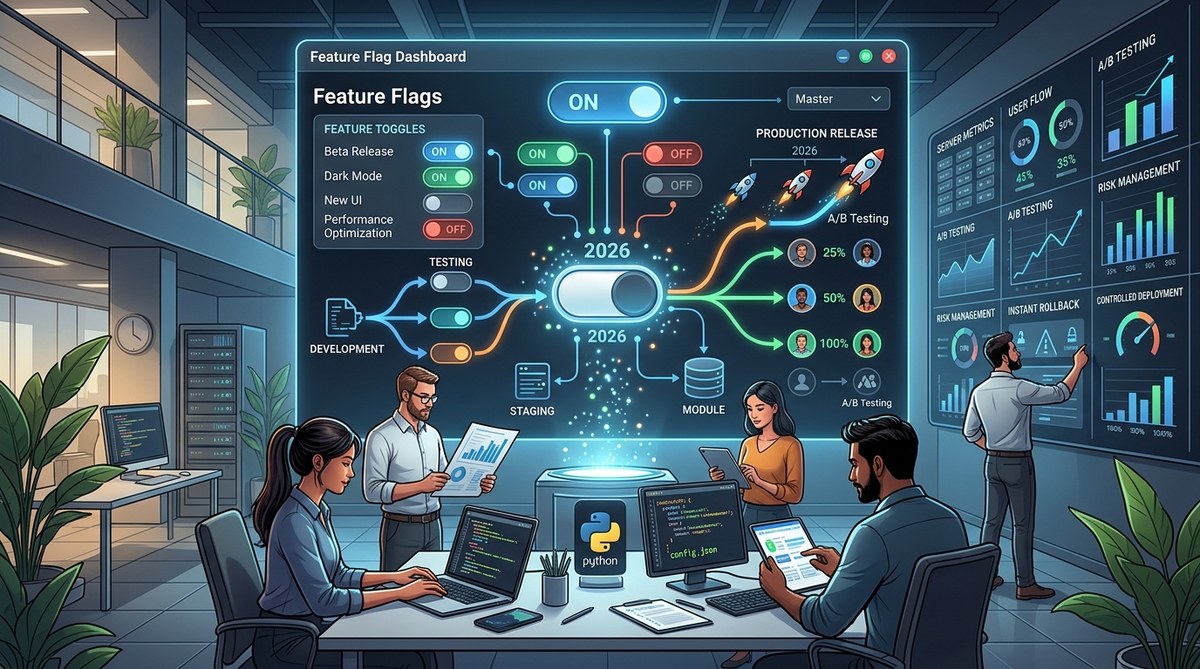
Your team just merged a big pull request. The build passed. Staging looked good. Then the deploy hit production and everything went sideways. A button broke. A database call timed out. The on call engineer got paged at 2 AM.
You know this story. Every engineering leader does.
The old way of doing things means you either block releases until everything is perfect (which slows you down) or you push code and pray. Neither option works well when your company is growing and your customers expect new features every week.
Feature flags change this equation. They let you separate deployment from release. You can ship code to production without making it visible to users. Then you turn it on when you are ready. If something breaks, you flip a switch instead of rolling back a commit.
This is not just a nice to have in 2026. It is a competitive necessity. Let me show you why.
Feature flags give your team the power to deploy code safely without waiting for every feature to be complete. They reduce deployment risk, enable targeted rollouts, and let you test in production with real users. The real benefit is faster release cycles without sacrificing stability. In 2026, teams that use feature flags ship more often and break fewer things. That is a direct win for your engineering org and your business.
Better Deployment Safety Without Slowing Down
The biggest fear for any engineering manager is a bad deploy. You push code at 4 PM on a Friday and suddenly your core checkout flow is down. Now you are scrambling to revert, your team is stressed, and your VP is asking questions.
Feature flags eliminate this pain. When you wrap a new feature behind a flag, that code lives in production but stays dark. You can test it, monitor it, and validate it before flipping the switch.
Here is how it works in practice:
- Write your new feature behind a flag check (if feature_flag_enabled: show new UI else show old UI)
- Deploy that code to production with the flag set to false
- Run smoke tests against the new code path using a test user or internal account
- Enable the flag for 1% of users and watch your metrics
- Gradually ramp up to 100% if everything looks clean
- If you see errors, disable the flag instantly
This process turns a high risk deploy into a controlled rollout. Your team can ship code every day without fear. And if something does go wrong, the fix is a configuration change, not a rollback.
Faster Release Velocity for Your Teams
Your developers hate waiting. They finish a feature, submit a PR, and then sit around while the release train builds. Maybe your team deploys once a week. Maybe once every two weeks. That lag time kills momentum.
Feature flags let you ship continuously. Developers can merge code to production as soon as their PR is approved. The feature just stays hidden until it is ready.
This changes your team dynamics in a few important ways:
- No more long lived feature branches that cause merge conflicts
- Smaller, more frequent deploys that are easier to review
- Developers own their features from commit to customer
- QA can test against production data instead of a stale staging environment
Your team will ship more code with less friction. That is a direct productivity win.
Targeted Rollouts and Canary Deployments
Rolling out a feature to every user at once is risky. What if your new search algorithm works great for power users but breaks for mobile users on slow connections? You will not know until everyone has it.
Feature flags let you target specific audiences. You can enable a feature for:
- Internal team members only
- Beta testers or early access users
- Users in a specific geographic region
- Users on a particular device type or browser
- A random percentage of traffic for A/B testing
This is how mature engineering organizations handle releases. They start small, measure impact, and expand gradually. It is safer. It is smarter. And it gives you data before you commit fully.
Testing in Production (The Right Way)
Testing in production has a bad reputation because people think it means pushing broken code to real users. That is not what we are talking about.
With feature flags, you can test new code paths against live traffic without exposing them to most users. You enable the flag for a small segment, watch your error rates and latency, and compare against the control group.
This is actually better than staging environment testing because:
- Production has real data, real traffic patterns, and real edge cases
- You catch issues that only appear at scale
- You validate performance under real load
- You get immediate feedback from actual user behavior
Your staging environment can never fully replicate production. Feature flags let you bridge that gap safely.
Kill Switches for Instant Incident Response
Every team has that one deploy that went wrong. You pushed a change, realized it was broken, and then spent 20 minutes reverting while users experienced errors. Twenty minutes is a long time when your app is down.
A feature flag is a kill switch. If a new feature starts causing problems, you disable the flag. The old code path takes over instantly. No rollback. No redeploy. No frantic git commands under pressure.
This is a huge quality of life improvement for your on call engineers. Instead of debugging a live incident while trying to revert, they just toggle a flag and stabilize the system. Then they can investigate the root cause calmly.
A/B Testing and Experimentation at Scale
Product teams love data. They want to know if the new onboarding flow converts better. They want to test two different pricing pages. They want to validate a new feature before committing to it.
Feature flags make this easy. You create a flag that splits traffic between control and treatment groups. Your analytics platform tracks the results. After a statistically significant period, you pick a winner.
This is not just for product experiments either. You can test infrastructure changes, database migrations, or API version upgrades the same way. Any change that affects user experience can be validated with a flag.
Common Mistakes Teams Make with Feature Flags
Feature flags are powerful, but they come with their own pitfalls. Here is a table of what to watch out for:
| Mistake | Why It Hurts | How to Avoid It |
|---|---|---|
| Keeping flags forever | Code becomes cluttered with dead conditions | Set a cleanup schedule and remove flags after rollout |
| Too many flags | Hard to reason about system state | Use a naming convention and limit active flags |
| No monitoring on flags | You cannot tell if a flag change caused an issue | Add metrics and alerts for flag toggles |
| Flags without tests | Flagged code paths are untested | Test both states of every flag in CI |
| Manual flag management | Human error causes incidents | Automate flag rollouts with your deployment pipeline |
How to Convince Your Team to Adopt Feature Flags
If you are reading this, you probably already see the value. But your team might push back. Here is how to make the case.
Start with a small pilot. Pick one team that ships frequently and has some deployment pain. Give them a feature flag tool and let them use it for one or two releases. Measure the results: deploy frequency, incident count, time to recover.
Then share those numbers with the rest of the org. Nothing convinces engineers like data from their peers.
“The teams that adopted feature flags in our org reduced rollback incidents by 80% in the first quarter. Developers reported feeling more confident about their deploys. That confidence alone was worth the investment.” – Senior Engineering Manager at a Series C SaaS company
You can also point to the broader trend. In 2026, feature flags are standard practice at every high performing engineering organization. They are not experimental anymore. They are expected.
Feature Flags Fit Into Your Existing Toolchain
You might worry that adding feature flags means another tool to manage. That is fair. Nobody wants to increase their tool sprawl.
But modern feature flag platforms integrate with what you already use. They connect to your CI/CD pipeline, your monitoring stack, your analytics tools, and your incident response system. Many of them offer SDKs for every major language and framework.
The integration work is usually a few hours per service. After that, your team uses feature flags through their normal workflow. Developers add flags in code. Ops manages them through a dashboard. The whole thing feels natural.
If you are looking for other ways to improve your team’s workflow, check out our guide on or our list of Feature flags work best when combined with a solid CI/CD foundation, which we cover in
Making Feature Flags Part of Your Culture
The technical side of feature flags is straightforward. You install an SDK. You wrap your code in conditionals. You configure flags in a dashboard. Done.
The harder part is the cultural shift. Your team needs to think differently about deployments. They need to accept that code can live in production without being active. They need to get comfortable with gradual rollouts instead of big bang releases.
This takes time. Start with one or two flags on a low risk feature. Show the team how it works. Celebrate the first time you avoid a rollback by flipping a flag. Build momentum from there.
Within a few months, your team will wonder how they ever shipped without them.
The Real Reason You Need Feature Flags in 2026
Here is the honest truth. Your competitors are already using feature flags. They are shipping faster, breaking fewer things, and learning from real user data. If you are not using them, you are falling behind.
Feature flags are not a nice to have for mature engineering teams. They are a baseline expectation. Your developers want them. Your product team wants them. Your business stakeholders want faster releases with less risk.
Feature flags deliver on all of that.
Start small. Pick a tool. Run a pilot. Measure the results. Then scale it across your org.
Your team will thank you. Your users will notice the difference. And your Friday afternoons will be a lot less stressful.
If you want to learn more about modern development practices, check out our or see how other teams are using to improve their workflow.
The best time to start using feature flags was last year. The second best time is today.
