alexander
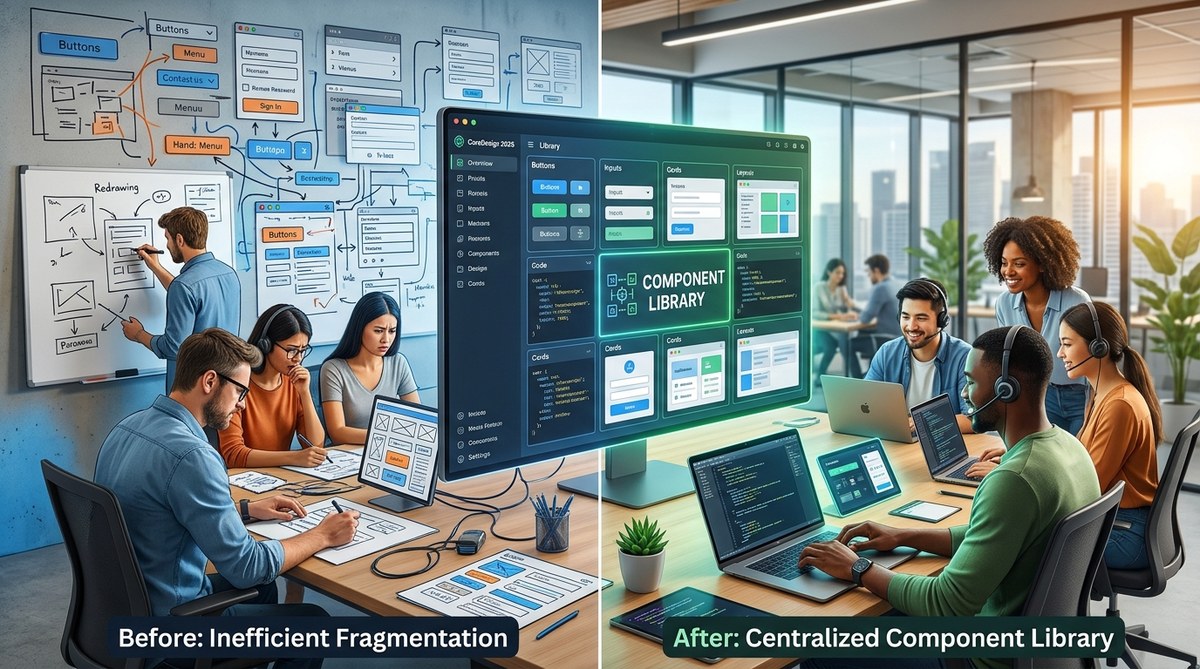
Your team just spent three sprints building a custom date picker. It looks great. It works perfectly. Then you find out the team across the hall built the exact same component last quarter. Theirs even handles time zones better. Sound familiar? This scene plays out in engineering organizations every single day. The fix is not to hire more people or buy more tools. The fix is a centralized component library.
A centralized component library in 2026 is no longer a nice to have. It is a foundational tool that eliminates duplicate work, enforces visual and functional consistency, and lets your team ship features faster. By treating components as shared assets rather than team specific code, you reduce technical debt and make onboarding new developers almost effortless.
The Real Cost of Building the Same Thing Twice
When you ask five frontend developers to build a modal dialog, you will get five different implementations. One uses absolute positioning. Another relies on flexbox. A third includes animation hooks. None of them share code. All of them need to be tested, documented, and maintained separately.
This duplication adds up fast. Every repeated component means more code to review, more edge cases to handle, and more surface area for bugs. The problem compounds as your team grows. What starts as a minor inefficiency becomes a major drag on velocity. A centralized component library 2026 strategy directly addresses this waste by creating a single source of truth for every reusable piece of your user interface.
What a Centralized Component Library Actually Looks Like
Think of it as a private npm package that lives inside your organization. It contains all the shared UI elements your applications use. Buttons, form fields, navigation bars, data tables, notification toasts. Each component is versioned, documented, and tested independently. Teams consume the library like any other dependency.
The library itself is not just a folder full of code snippets. It is a living system with its own CI/CD pipeline, automated tests, visual regression checks, and release process. When a developer needs a dropdown menu, they do not write one from scratch. They import the official dropdown from the library. If the dropdown needs a new feature, they contribute back to the library instead of forking the code.
The Tangible Benefits You Can Measure
A well run centralized component library delivers results you can actually track. Here are the most important ones.
- Reduced development time. Teams stop rebuilding standard components. They focus on business logic instead.
- Consistent user experience. Every application uses the same button styles, spacing, and interaction patterns.
- Lower maintenance burden. Fix a bug in one place and every consuming application gets the fix.
- Faster onboarding. New developers learn one set of components instead of each team’s custom patterns.
- Easier design handoffs. Designers work from a known palette of components, so mockups translate directly to code.
Common Mistakes That Derail Component Libraries
Even with the best intentions, many teams get this wrong. The table below shows the most frequent pitfalls and how to avoid them.
| Mistake | What Happens | How to Fix It |
|---|---|---|
| Building too many components at once | The library becomes bloated and hard to maintain | Start with the 10 most used components and expand gradually |
| No governance or review process | Low quality components pollute the library | Require code reviews and design sign off for every addition |
| Ignoring versioning and breaking changes | Consuming applications break on updates | Use semantic versioning and provide migration guides |
| Treating it as a documentation project | The library gathers dust because nobody uses it | Integrate the library into your CI/CD pipeline so teams adopt it naturally |
| Not including design tokens | Developers guess at colors and spacing | Share design tokens and theme variables alongside the components |
How to Build Your Centralized Component Library in 2026
Getting started does not require a massive upfront investment. Follow these steps to create a library that your team will actually use.
-
Audit your existing codebase. Look for patterns that repeat across projects. Buttons, modals, form inputs, and data tables are usually the top candidates. Count how many unique implementations exist for each pattern.
-
Pick one component and standardize it. Do not try to build everything at once. Choose the component that appears most frequently in your applications. Refactor it into a single, well tested version. Document its API and publish it as a package.
-
Set up a dedicated repository. Your component library deserves its own repo with its own CI pipeline. Include automated visual regression tests using tools like Percy or Chromatic. Add linting rules that enforce consistency.
-
Establish contribution guidelines. Write clear rules for how teams add new components. Require documentation, test coverage, and accessibility checks. Make the process simple enough that developers want to contribute but strict enough that quality stays high.
-
Integrate with your design system. Connect your component library to your design tokens and style dictionaries. When designers update a color or spacing value, the change should flow automatically into the components.
-
Measure adoption and iterate. Track how many teams use the library and how often. Monitor the number of duplicate components being created outside the library. Use this data to prioritize improvements.
“The teams that succeed with component libraries treat them as products, not projects. They invest in documentation, listen to feedback, and make it easier to use the library than to bypass it.” – A senior frontend architect at a major ecommerce company
Picking the Right Tools for Your Stack
Your technology choices will depend on your existing ecosystem, but some patterns hold true across most stacks. For React projects, consider building on top of Storybook with a publishing workflow that pushes to a private npm registry. For Vue or Angular, similar tools exist with comparable workflows.
If your team uses multiple frameworks, you might need a language agnostic approach. Some teams build their component library using pure HTML and CSS with JavaScript for interactivity. Others use Web Components for maximum portability. The right choice depends on your team’s skill set and your application architecture.
Do not overlook the importance of a good development environment. Tools like can help you set up a workspace that makes contributing to the library painless. Pair that with a solid to automate your testing and deployment.
Governance and Maintenance
A component library that nobody maintains is worse than no library at all. Assign a small team of maintainers. This group reviews contributions, manages releases, and communicates changes to consuming teams. Rotate maintainers every six months to prevent burnout and spread knowledge.
Create a clear deprecation policy. When a component needs to be replaced, announce the change well in advance. Provide a migration path and a timeline. Give teams time to update their applications before removing the old component.
Measuring Success Beyond Velocity
Velocity matters, but it is not the only metric. Track how often your library reduces bug reports. Measure the time it takes to spin up a new microservice or landing page. Look at the consistency of your user interface across different products. These qualitative improvements often matter more than raw sprint points.
You can also track the number of pull requests that modify library components versus application specific code. A healthy library sees steady contributions from multiple teams. If only one team maintains everything, you have a bus factor problem that needs attention.
When a Centralized Component Library Is Not the Answer
Honesty matters here. If your organization has fewer than five developers, a formal component library might be overkill. You are better off with a shared snippets folder and good communication. Similarly, if your product is a single monolithic application with no plans to expand, the overhead of a separate library may not pay off.
But if you are reading this as a tech lead at a mid sized or large organization, the math almost always works in your favor. The upfront investment of a few weeks pays for itself within a quarter. After that, it is pure savings.
One Library, Many Applications
The real power of a centralized component library 2026 strategy comes from scale. When you have ten applications all using the same dialog component, a single accessibility fix reaches every user. A visual refresh touches every product. A performance optimization benefits the entire organization.
This is the same principle that makes open source software so powerful. Shared code, maintained by many, used by many. You are applying that model inside your own company. The result is less duplication, more consistency, and happier developers.
Start Small and Prove the Value
Do not try to boil the ocean. Pick one component that causes the most pain. Maybe it is your navigation bar, which every team builds slightly differently. Maybe it is your form validation logic, which keeps getting implemented with subtle bugs. Fix that one thing. Package it. Document it. Show your team how much easier life becomes.
Once they see the benefit, they will ask for more. That is when you know your centralized component library has taken root. From there, it grows organically as teams contribute their own patterns and improvements.
Making the Library Indispensable
The ultimate goal is to make your component library so useful that teams cannot imagine working without it. That means investing in discoverability. Create a searchable catalog where developers can find components, read documentation, and see live examples. Use tools like Storybook or a custom dashboard to make browsing feel natural.
Integrate the library into your onboarding process. Every new developer should learn about the library on their first day. Show them how to use existing components and how to contribute new ones. This sets the standard from the start.
A Shared Foundation for the Whole Team
A centralized component library is not just a technical artifact. It is a shared foundation that aligns your engineering team around common standards. When everyone uses the same building blocks, code reviews become faster. Design reviews become simpler. Cross team collaboration becomes natural.
The library becomes a living record of your organization’s best practices. Every component carries the lessons learned from previous iterations. New team members benefit from the experience of everyone who came before them. Old mistakes do not get repeated.
Your Next Step
Take a look at your current codebase. Find the component that has been implemented the most times. That is your starting point. Refactor it into a shared package. Publish it. Tell your team about it. Watch what happens.
The teams that adopt a centralized component library in 2026 are the ones that will ship faster, break less, and sleep better at night. The alternative is to keep rebuilding the wheel, sprint after sprint, while your competitors move ahead. The choice is yours.